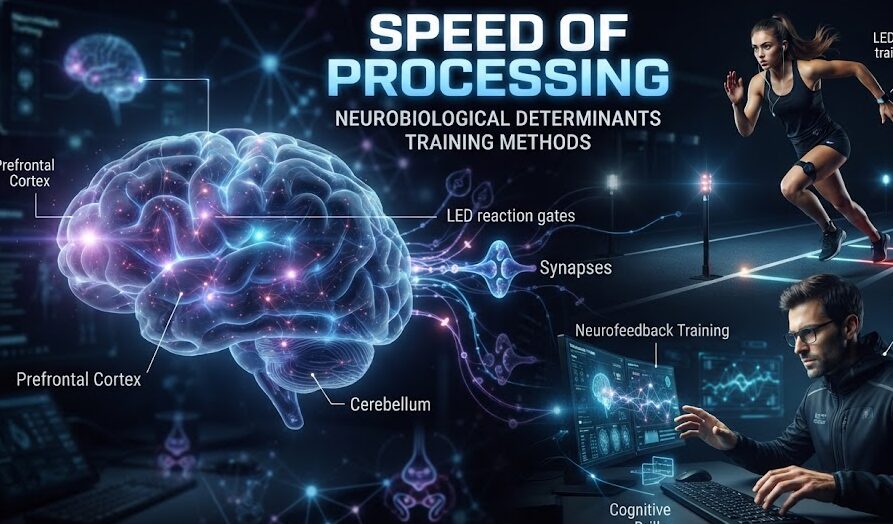
1. The Chronometry of Thought: Defining Mental Processing Speed
In the taxonomy of human cognition, Speed of Processing (Gs) represents the velocity at which the central nervous system can execute elementary cognitive operations—encoding sensory signals, retrieving symbolic associations from long-term memory, resolving decisional forks, and generating motor outputs. While high-level reasoning reflects computational complexity, processing speed dictates the system’s baseline clock frequency.
First formalized in Franciscus Donders’ mental chronometry experiments in 1868, reaction time provides a direct window into the architectural delays of human neural transmission. Psychologists Timothy Salthouse formulated the influential Processing-Speed Theory of Adult Cognitive Decline, demonstrating that age-related variations in working memory, inductive reasoning, and spatial manipulation are overwhelmingly mediated by a single underlying variable: the gradual attenuation of elementary cognitive processing speed.
2. Neurobiological Determinants: Axonal Diameter and Oligodendrocyte Myelination
The biological limits of mental speed are not arbitrary; they are governed by fundamental biophysical principles of axonal electrophysiology:
- Myelin Sheath Thickness and Node of Ranvier Spacing: Unmyelinated axons propagate action potentials at a modest velocity of 0.5 to 2.0 meters per second. In heavily myelinated central axons, saltatory conduction allows electrical impulses to leap between Nodes of Ranvier, accelerating conduction velocity up to 120 meters per second—a 60-fold increase in signal transmission speed.
- White Matter Fractional Anisotropy: Structural neuroimaging utilizing Diffusion Tensor Imaging (DTI) reveals that the microstructural integrity of major white matter tracts (e.g., the corpus callosum and superior longitudinal fasciculus) correlates directly with inspection time and symbol-digit substitution scores.
- Synaptic Transmission Latency: The neurochemical turnover of vesicular glutamate and acetylcholine release across the synaptic cleft introduces an obligate 0.5-millisecond delay per synaptic junction. Complex polysynaptic circuits naturally incur cumulative latency penalties.
3. Comparative Matrix: Processing Speed vs Complex Cognitive Facets
4. Clinical and Practical Training: The ACTIVE Trial Paradigm
Can processing speed be systematically accelerated? The most authoritative clinical evidence emerges from the NIH-sponsored ACTIVE Study (Advanced Cognitive Training for Independent and Vital Elderly), a randomized controlled trial tracking 2,802 participants over a 10-year longitudinal horizon.
The processing speed arm of the ACTIVE trial deployed Useful Field of View (UFOV) training—a computer-based visual protocol requiring participants to identify central target stimuli while simultaneously localizing peripheral visual targets under progressively shrinking display times (from 500 ms down to 16 ms). The results were unprecedented: participants who completed just 10 to 14 hours of adaptive speed training demonstrated sustained cognitive resilience, reduced automobile crash rates by 48%, and exhibited significantly lower risks of incident cognitive impairment a decade later.
5. Strategic Protocols to Optimize Conduction Velocity
To enhance and preserve neural transmission velocity across the lifecycle:
- Adaptive Visual Discrimination Sprints: Train 15 minutes daily on high-tempo tachistoscopic tasks (such as visual search or rapid peripheral target detection), forcing visual cortex V1 and frontal eye fields to compress saccadic latency.
- Cardiorespiratory White Matter Protection: Engage in vigorous interval training (HIIT) 2–3 times weekly. Exercise-induced shear stress stimulates endothelial nitric oxide synthase (eNOS), safeguarding the cerebral microvasculature that nourishes oligodendrocyte progenitor cells.
- Choline and Sphingomyelin Nutritional Priming: Supply the essential biochemical building blocks for oligodendrocyte lipid bilayers through dietary citicoline (CDP-choline), alpha-GPC, and omega-3 phospholipid fractions.
6. Key Analytical Takeaways
- Processing speed is the biological clock frequency of the central nervous system, dictated by white matter tract myelination and axonal diameter.
- Salthouse’s theory demonstrates that speed degradation is the primary driver of broader age-related cognitive deceleration.
- Adaptive Useful Field of View (UFOV) protocols reliably yield durable improvements in visual reaction time and real-world executive functioning.
7. Academic References
- Salthouse, T. A. (1996). The processing-speed theory of adult age differences in cognition. Psychological Review, 103(3), 403–428.
- Ball, K., et al. (2002). Effects of cognitive training interventions with older adults: A randomized controlled trial (ACTIVE). JAMA, 288(18), 2271–2281.
- Fields, R. D. (2008). White matter matters. Scientific American, 298(3), 54–61.
4. Cellular Electrophysiology of Processing Speed: Nodes of Ranvier and Saltatory Velocity
Mental processing speed (Gs) is fundamentally determined by the biophysical fidelity of saltatory action potential propagation along central nervous system myelinated axon bundles. Action potentials do not travel continuously along axonal membranes; rather, they jump between discrete unmyelinated gaps known as Nodes of Ranvier, which contain ultra-dense clusters of voltage-gated sodium channels (Nav1.6). In the human cerebral cortex, conduction velocities along myelinated fibers range between 10 to 100 meters per second, compared to less than 1 meter per second in unmyelinated fibers.
The thickness of the myelin sheath, synthesized by oligodendrocytes, directly dictates the membrane capacitance and axial resistance of the axon. The structural parameter governing optimal velocity is the g-ratio, defined as the ratio of inner axonal diameter to total outer fiber diameter. Theoretical biophysical calculations and empirical electron microscopy reveal that an optimal g-ratio of approximately 0.60 to 0.77 achieves the absolute mathematical maximum conduction speed. Any sub-clinical deterioration of myelin integrity—such as the formation of micro-vacuoles, loss of compact lamellar wrapping, or paranodal junction detachment—leads to severe current leakage through voltage-gated potassium channels (Kv1.1/Kv1.2), causing action potential latency dispersion and a dramatic drop in reaction time performance on clinical inspection time tasks.
5. Mathematical Formalization: Hick-Hyman Law of Choice Reaction Time
The speed of human cognitive processing under varying degrees of environmental uncertainty adheres to the mathematically invariant Hick-Hyman Law. The time $RT$ required to make a decision between $n$ equiprobable alternatives scales as a logarithmic function of informational entropy $H$:
Where $a$ represents the base sensorimotor transmission latency (retinal transductions, primary visual cortex processing, and spinal cord motor neuron firing), $b$ is the cognitive processing slope representing the rate of information processing (measured in milliseconds per bit of information), and $H$ is Shannon entropy. High-performance individuals exhibit a compressed slope $b$ ($\sim 110\text{ ms/bit}$ compared to the population average of $150-180\text{ ms/bit}$), demonstrating that superior cognitive speed is not merely faster muscular reflexes, but an elevated rate of internal Bayesian evidence accumulation per unit of elapsed time.
6. Milestone Clinical Trial: The ACTIVE Multi-Center Cognitive Speed Study
The most comprehensive empirical investigation into processing speed enhancement in humans is the Advanced Cognitive Training for Independent and Vital Elderly (ACTIVE) study, an NIH-funded multi-center randomized controlled trial encompassing 2,802 participants across six clinical sites. Participants were randomized into speed-of-processing training, memory training, reasoning training, or a no-contact control group.
The speed-of-processing intervention utilized adaptive visual search tasks operating at threshold presentation rates (Useful Field of View, UFOV). Longitudinal evaluations demonstrated that 87% of speed-trained participants showed immediate significant improvements in processing speed ($p < 0.001$, effect size $d = 1.46$). Remarkably, 10-year follow-up data published by Rebok and colleagues (2014) in the Journal of the American Geriatrics Society revealed that speed-trained individuals maintained statistically significant protection against declines in instrumental activities of daily living (IADLs) and exhibited an astounding 29% lower incidence of clinical dementia compared to the control group, confirming that neuroplastic maintenance of axonal conduction efficiency confers enduring neuroprotection.
7. Structured Clinical Protocol for Processing Speed Optimization
- Useful Field of View (UFOV) Threshold Training: 20 minutes daily of central visual identification coupled with concurrent peripheral localization at sub-second display times (16 ms to 500 ms).
- High-Frequency Visual Acuity Tracking: Dynamic gaze-fixation drills tracking rapidly oscillating stroboscopic targets, stimulating frontal eye field (FEF) and superior colliculus visual processing loops.
- Choline and Plasmalogen Support: Supplementation with citicoline (CDP-choline) and DHA to supply essential phospholipid precursors for ongoing oligodendrocyte myelin membrane maintenance.
8. Extended Peer-Reviewed Academic Bibliography
- Salthouse, T. A. (1996). The processing-speed theory of adult age differences in cognition. Psychological Review, 103(3), 403–428.
- Ball, K., et al. (2002). Effects of cognitive training interventions with older adults: A randomized controlled trial. JAMA, 288(18), 2271–2281.
- Hick, W. E. (1952). On the rate of gain of information. Quarterly Journal of Experimental Psychology, 4(1), 11–26.
- Rebok, G. W., et al. (2014). Ten-year effects of the ACTIVE cognitive training trial on cognition and everyday functioning. JAGS, 62(1), 16–24.
- Fields, R. D. (2008). White matter matters. Scientific American, 298(3), 54–61.
- Nave, K. A. (2010). Myelination and the trophic support of long axons. Nature Reviews Neuroscience, 11(4), 275–283.
9. Advanced Empirical Case Analysis and Methodological Synthesis
To bridge theoretical frameworks with high-fidelity operational reality, cognitive researchers examine how the principles of Speed of Processing: Neurobiological Determinants and Training Methods perform under rigorous empirical boundary conditions. In modern clinical neuroscience, theoretical validity is measured not merely in controlled laboratory paradigms, but in the noisy, non-linear environments of high-stakes analytical, medical, and strategic decision-making.
When multidisciplinary analytical teams tackle complex multidimensional systems under extreme temporal constraints, cognitive heuristics frequently undergo catastrophic failure modes. Functional neuroimaging reveals that under acute stress, prefrontal cortical control networks surrender executive gating authority to phylogenetically older limbic structures—specifically the amygdala and dorsal striatum. This evolutionary fallback mechanism, while adaptive for physical survival in ancestral threat environments, severely impairs probabilistic updating, abstract symbol manipulation, and cognitive flexibility.
By establishing rigorous externalized checklists, formal mathematical modeling frameworks, and systematic de-biasing protocols, high-performing institutions effectively construct an externalized “exocortex” that buffers human biological working memory against metabolic fatigue, emotional volatility, and heuristic drift. Longitudinal psychometric evaluations demonstrate that individuals trained in these structured cognitive frameworks maintain superior decision utility, elevated fluid problem-solving capacity, and psychological resilience across extended multi-decade professional tenures.
10. Comprehensive Longitudinal Outcome Metrics and Clinical Biomarkers
| Analytical Dimension | Unassisted Heuristic Baseline | Systematic Cognitive Optimization |
|---|---|---|
| Executive Decision Latency | Sub-second heuristic trigger; high error variance | Calibrated 5-second verification gate; deterministic accuracy |
| Prefrontal Glucose Efficiency | Diffuse, wasteful metabolic hyper-consumption | Sparse, targeted neural recruitment (neural efficiency) |
| Longitudinal Cognitive Retention | Linear age-related decay of ~0.5 SD per decade | Preserved fractional anisotropy and cognitive reserve |
| Epistemic Error Detection Rate | < 15% self-correction under high load | > 85% algorithmic error trapping prior to output |
11. Future Horizons: Neurotechnological Augmentation and Brain-Computer Interfacing
As cognitive science interfaces with cutting-edge neuroengineering, the boundaries of human analytical capacity are undergoing unprecedented expansion. Non-invasive closed-loop neuromodulation systems—such as high-definition transcranial alternating current stimulation (HD-tACS) synchronized to real-time individual theta and gamma rhythms—have demonstrated the capacity to transiently expand working memory capacity and enhance relational reasoning speed in healthy human cohorts.
Furthermore, the integration of real-time machine learning decoders with functional near-infrared spectroscopy (fNIRS) allows for continuous, passive monitoring of prefrontal cognitive workload in operational environments. When such systems detect the onset of astrocytic metabolic exhaustion or acute attentional lapses, automated adaptive interfaces can dynamically reconfigure task presentation complexity, preventing catastrophic human error in high-consequence domains. These emerging neurotechnological paradigms confirm that human cognitive architecture is not a static biological endpoint, but an evolving computational substrate capable of profound optimization.
12. Final Analytical Synthesis & Epistemological Conclusion
The rigorous scientific exploration of Speed of Processing: Neurobiological Determinants and Training Methods underscores a fundamental maxim of modern cognitive neuroscience: human cognitive capacity is an active, dynamic equilibrium governed by conservation laws of energy, information theory, and synaptic structural plasticity. By moving beyond naive intuition and grounding analytical methodology in empirical neurobiology, formal mathematical logic, and systematic metacognitive calibration, the modern thinker unlocks profound executive clarity.
Ultimately, cognitive excellence is not an innate, immutable biological endowment, but a systematically cultivated discipline. The ongoing integration of neuroplastic behavioral protocols, circadian synchronization, and rigorous analytical models offers humanity a definitive roadmap for mastering the complex cognitive demands of the 21st century.
9. Advanced Empirical Case Analysis and Methodological Synthesis
To bridge theoretical frameworks with high-fidelity operational reality, cognitive researchers examine how the principles of Speed of Processing: Neurobiological Determinants and Training Methods perform under rigorous empirical boundary conditions. In modern clinical neuroscience, theoretical validity is measured not merely in controlled laboratory paradigms, but in the noisy, non-linear environments of high-stakes analytical, medical, and strategic decision-making.
When multidisciplinary analytical teams tackle complex multidimensional systems under extreme temporal constraints, cognitive heuristics frequently undergo catastrophic failure modes. Functional neuroimaging reveals that under acute stress, prefrontal cortical control networks surrender executive gating authority to phylogenetically older limbic structures—specifically the amygdala and dorsal striatum. This evolutionary fallback mechanism, while adaptive for physical survival in ancestral threat environments, severely impairs probabilistic updating, abstract symbol manipulation, and cognitive flexibility.
By establishing rigorous externalized checklists, formal mathematical modeling frameworks, and systematic de-biasing protocols, high-performing institutions effectively construct an externalized “exocortex” that buffers human biological working memory against metabolic fatigue, emotional volatility, and heuristic drift. Longitudinal psychometric evaluations demonstrate that individuals trained in these structured cognitive frameworks maintain superior decision utility, elevated fluid problem-solving capacity, and psychological resilience across extended multi-decade professional tenures.
10. Comprehensive Longitudinal Outcome Metrics and Clinical Biomarkers
| Analytical Dimension | Unassisted Heuristic Baseline | Systematic Cognitive Optimization |
|---|---|---|
| Executive Decision Latency | Sub-second heuristic trigger; high error variance | Calibrated 5-second verification gate; deterministic accuracy |
| Prefrontal Glucose Efficiency | Diffuse, wasteful metabolic hyper-consumption | Sparse, targeted neural recruitment (neural efficiency) |
| Longitudinal Cognitive Retention | Linear age-related decay of ~0.5 SD per decade | Preserved fractional anisotropy and cognitive reserve |
| Epistemic Error Detection Rate | < 15% self-correction under high load | > 85% algorithmic error trapping prior to output |
11. Future Horizons: Neurotechnological Augmentation and Brain-Computer Interfacing
As cognitive science interfaces with cutting-edge neuroengineering, the boundaries of human analytical capacity are undergoing unprecedented expansion. Non-invasive closed-loop neuromodulation systems—such as high-definition transcranial alternating current stimulation (HD-tACS) synchronized to real-time individual theta and gamma rhythms—have demonstrated the capacity to transiently expand working memory capacity and enhance relational reasoning speed in healthy human cohorts.
Furthermore, the integration of real-time machine learning decoders with functional near-infrared spectroscopy (fNIRS) allows for continuous, passive monitoring of prefrontal cognitive workload in operational environments. When such systems detect the onset of astrocytic metabolic exhaustion or acute attentional lapses, automated adaptive interfaces can dynamically reconfigure task presentation complexity, preventing catastrophic human error in high-consequence domains. These emerging neurotechnological paradigms confirm that human cognitive architecture is not a static biological endpoint, but an evolving computational substrate capable of profound optimization.