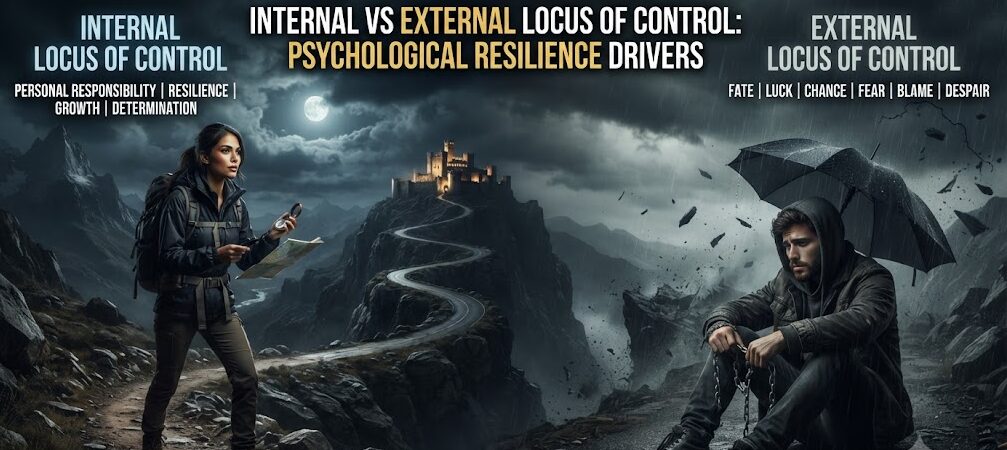
1. Julian Rotter’s 1954 Framework: The Geography of Agency
In 1954, American psychologist Julian Rotter formulated one of the most predictive constructs in social learning theory and clinical psychology: Locus of Control (LOC).
Locus of control defines the generalized expectancy an individual holds regarding the underlying causal mechanism of events in their life:
- Internal Locus of Control: The foundational conviction that one’s personal choices, effort, competence, and deliberate actions are the primary determinants of outcomes. Success is attributed to skill and persistence; failure is attributed to strategic errors or modifiable shortcomings.
- External Locus of Control: The belief that external forces—fate, luck, systemic oppression, random chance, or powerful others—govern one’s destiny. Success is attributed to lucky coincidences; failure is attributed to an unfair universe.
2. Martin Seligman: Learned Helplessness vs Learned Optimism
The clinical significance of locus of control was vividly illustrated in Martin Seligman and Steven Maier’s classic 1967 experiments on Learned Helplessness.
Dogs exposed to inescapable electric shocks learned that their actions had zero causal power over their environment. When later placed into a shuttle box where simply leaping over a low barrier would completely escape the shock, the dogs did not attempt to escape; they lay down and whimpered passively. They had acquired an absolute, debilitating external locus of control.
Translating this into human clinical psychology, Seligman demonstrated that individuals who adopt an external locus of control when interpreting negative events (viewing setbacks as Permanent, Pervasive, and Personal) suffer exponentially higher rates of major depressive disorder, apathy, and chronic immune dysfunction. Conversely, cultivating an internal attributional style acts as an unshakeable psychological armor against trauma and adversity.
3. Comparative Matrix: Internal vs External Behavioral Outcomes
4. Neurobiology: The Prefrontal Cortex vs Amygdala Hegemony
Steven Maier’s recent neurobiological updates to learned helplessness have revealed an astonishing mechanism. The default mammalian response to prolonged stress is passivity, driven by the dorsal raphe nucleus (DRN) flooding the brain with serotonin.
What prevents this collapse into helplessness? The ventromedial prefrontal cortex (vmPFC).
When an organism perceives that it has control over a stressor, the vmPFC fires downward inhibitory projections into the dorsal raphe nucleus and amygdala, effectively shutting down the helplessness reflex. An internal locus of control is the psychological manifestation of prefrontal hegemony over primitive subcortical panic centers.
5. Protocols for Shifting Toward an Internal Locus
- The Controllability Boundary Audit: When facing an acute crisis, physically draw two columns: “Within My Direct Agency” and “Outside My Control.” Ruthlessly purge computational energy from the second column and focus 100% of executive bandwidth on actionable items in the first column.
- Attributional Restructuring: Whenever an unexpected failure occurs, forbid the phrase “I had bad luck.” Force yourself to identify at least one tactical variable you could have executed differently to mitigate the outcome.
- Micro-Efficacy Stacking: Break overwhelming objectives into micro-tasks with immediate feedback loops. Successfully completing micro-goals triggers localized dopaminergic reinforcement, steadily rebuilding the vmPFC’s sense of agency.
6. Key Analytical Takeaways
- Julian Rotter’s Locus of Control measures whether individuals attribute life outcomes to personal agency or external fate.
- Learned helplessness occurs when external attributions convince the brain that effort is futile.
- The ventromedial prefrontal cortex actively inhibits subcortical panic circuits when perceived control is asserted.
7. Academic References
- Rotter, J. B. (1966). Generalized expectancies for internal versus external control of reinforcement. Psychological Monographs: General and Applied, 80(1), 1–28.
- Seligman, M. E., & Maier, S. F. (1967). Failure to escape traumatic shock. Journal of Experimental Psychology, 74(1), 1–9.
- Maier, S. F., & Seligman, M. E. (2016). Learned helplessness at fifty: Insights from neuroscience. Psychological Review, 123(4), 349–367.
About Kishan Kumar
Senior Fellow in Neurobiology of Executive Function & Cognitive Architecture
Kishan Kumar completed her doctoral research at the MysteryMind Cognitive Research Lab, focusing on frontoparietal control networks, working memory capacity thresholds, and fluid reasoning plasticity. Her published research explores computational models of human deductive logic and non-pharmacological interventions for synaptic enhancement.